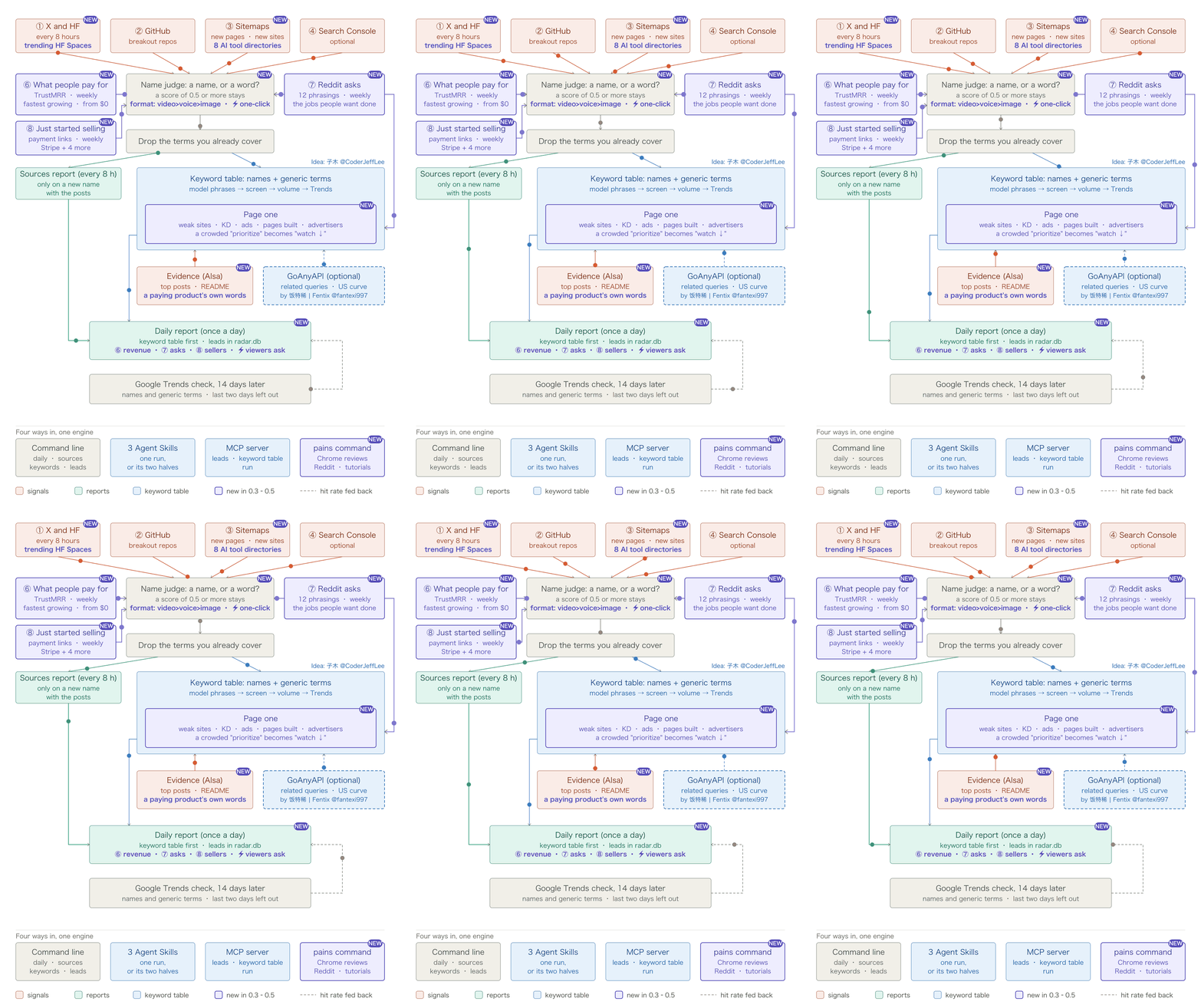
A daily report of the names that are starting to surge in AI: new models, products, tools and repos, caught where they are said first, before they show up in keyword tools.
Built for people who make pages, posts or products around new terms: SEO for AI tool sites, newsletters, directories, anyone who wants to know about "Strata" or "Seedance" the day it appears and not two weeks later.
A new name leaves a trail, in this order:
Keyword tools read step 5. This radar reads steps 1 to 4 every day and uses step 5 only to check itself.
One example it was built around: Niko1221/Strata was created on 2026-09-24 and had 7,700 stars nine days later. People were searching "niko strata" from 9/26, while no second repo carried the name and no keyword tool listed it. A single repo gaining 800 stars a day is the whole signal, and it is public.
Purple, tagged NEW: what 0.3 to 0.5 added (⑥ revenue, ⑦ Reddit asks, ⑧ sellers, the page-one check, the format and ⚡ marks, the pains command).
| Signal | What it catches | Needs | Cost |
|---|---|---|---|
| ① X | Names the accounts in your list used for the first time in 60 days | AIsa key | $0.003 per account per run |
| ① Hugging Face | Models and Spaces (the demos people try) new to the trending top 50; quantised copies and a model's own demo grouped under the base name | nothing | free |
| ② GitHub breakout | A repo under 14 days old averaging 200+ stars a day, or +400 since yesterday; adds the search variants people use ("niko strata") | nothing (a GitHub token raises the rate limit) | free |
| ③ Sitemaps | Words that several new URLs on a site share and its older URLs rarely carried. The example config watches eight AI tool directories (toolify, aixploria, ai-bot.cn, opentools, dang.ai, clipfly, aitoptools, futurepedia) and four MCP and skill directories | the sitemaps you list | free |
| ③ New sites | Domains registered and first indexed in the last 90 days that already rank for 20+ keywords | AIsa key | about $0.13 per query, weekly |
| ⑦ Asks | What people ask for on Reddit ("is there an AI tool that…", twelve phrasings): a model keeps the requests and complaints an AI tool could answer and writes each job as people would search it; jobs with searches get the page-one check | AIsa key | about $0.12 a week |
| ⑧ Sellers | Sites that just put up a payment link (Stripe Payment Links, Polar, Lemon Squeezy, Gumroad, Creem), from the public link graph with the day each link first appeared; platform pages and forum threads left out; the site's own description goes to the keyword table | AIsa key; GoAnyAPI optional, for visits | about $0.25 a week |
| ⑥ Revenue | Products people pay for, from TrustMRR's verified revenue: the fastest growing ($500+ in 30 days) and the newest listings; one at $0 last time and earning now is called out first. Its own description goes to the keyword table as evidence | TrustMRR key | free, 6 requests, weekly |
| ④ Search Console | Queries your site got impressions for, for the first time (fresh data) | your own Google token | free |
| ⑤ Review | Each lead checked in Google Trends 14 days later, against its own baseline; hit rate and days ahead per signal | AIsa key | $0.0012 per search variant |
| Keyword table | For the day's new names: the generic search terms behind them (what people do with the new thing), each sized, checked for room on page one, and given a decision | AIsa key; GoAnyAPI key optional | about $0.18 a day for 5 names, $0.30 with GoAnyAPI |
| Name judge | A small model scores every term: the name of one specific thing, or a common word? | AIsa key | a fraction of a cent per run |
Prices are what AIsa charged in October 2026. With the example config (35 X accounts read three times a day, the keyword table for 5 names a day) a month costs about $15: $10 for the X reads, $5 for the keyword table. Read fewer accounts, or read them once a day, and it drops in proportion.
A name is half of what you need. "SynthID Detector" has a short life as a keyword and belongs to Google; the job it does, "ai image detector", is what people keep searching, and nobody owns it. Each day the radar reads the new names once more and writes one table with both:
| Keyword | Type | Behind | New? | Est. searches/day | Started rising | Peak vs gpts | Peak day | Last 7 days vs the 7 before | Now | Page one | Decision |
| **photocraft** 🖼 | name | — | yes | 12747 | 2026-10-05 | 97 vs 3.1 | 2026-10-09 | — | still rising | — | **prioritize** |
| **claude haiku 5.5** | name | — | yes | 1863 | 2026-10-07 | 100 vs 23.7 | 2026-10-08 | ×6.0 | still rising | — | **prioritize** |
| **ai image detector** 🖼 | generic | synthid detector | no | 2537 | — | 87 vs 31.6 | 2026-10-04 | ×1.2 | flat | — | watch |
| **photoshop alternative** ⚠ | generic | photocraft | no | 244 | — | 61 vs 61.7 | 2026-10-08 | ×1.8 | flat | — | skip |
(a real run, 2026-10-12, shortened; the Page one column came later, see below)
How it is made (radar/usecases.py):
min_volume are dropped; most are.gpts by default) gives the size.pages built) and the domains running Google ads on it (advertisers, from Ads transparency), $0.008 a row. open = three or more of the ten results sit on sites rated under 30, or difficulty under 20; crowded = none does and difficulty is 40 or more; mixed in between. Under the table it names the weakest site on page one, where a new page can get in, and what kinds of pages hold it (tools, lists, articles, videos, forums). Ads on the page mean someone pays for that click.Searches a day are estimates. A generic term's come from its own Google Ads volume, moved to today along its own Trends curve. The benchmark is then sized from those terms, and a name, which has no volume data yet, is sized against the benchmark.
Decision: prioritize = rose in the last 30 days, still up, at least min_daily searches a day. watch = rose but smaller, too early to read, or flat with steady demand of that size. skip = fading, or flat and small. A prioritize whose page one is crowded becomes watch ↓: still rising, but page one belongs to strong sites. In a name's first week page one is still forming (news, the maker's own pages); the second reading three days later is the one to trust.
Marks: 🎬 video, 🎙 voice, 🖼 image says what the thing makes, the usual order of what visitors pay for (video > voice > image > text); leads of equal standing are sorted by it. ⚡ = a post with 1,000 or more likes walks through a manual workflow or rides a trend: a one-click tool nobody has built yet. Both come from keyword rules over the lead's own words and posts; on six known names (Nano Banana, Veo 3.1, Seedance 2.5, Claude Opus 5.5, ElevenLabs v4, Qwen Image 2.1) the format came out right for all six and ⚡ fired once, on a widely shared Opus 5.5 + Blender + Unreal walkthrough. Read the posts before acting on a mark.
Each name is read twice, the day it appears and three days later, because on announcement day the posts are announcements and no use shows yet. The generic terms are kept as leads and reviewed after 14 days like the names.
What to expect from it, from the first eight names we ran it on:
still rising (US).The table is still written, but it gets thinner, and it says which part is missing:
| What happens | What the table loses | The line it prints |
|---|---|---|
No GOANYAPI_API_KEY (the default) |
The 🔎 rows, each name's long-tails, the other names searched alongside, and the (US) readings. Phrases come from the model alone and every curve from the worldwide series, where a real move can read flat |
"Related queries are off: set GOANYAPI_API_KEY…" |
| GoAnyAPI's Trends is down (seen on its first day in use, 2026-10-12) | The same as having no key, for that run | "Related queries failed for: …" and "Country series failed, worldwide data used instead: …" |
| AIsa's post search fails for a name (timeouts seen twice on 2026-10-13) | That name's posts. A repository still has its README; a model or product without one is left with the related queries only, and with no GoAnyAPI key it gets no generic terms that day | "The post search failed; this run used READMEs and related queries only: …" |
| Neither posts nor a README for a name | Its generic terms; the name's own row stays | "No posts or README found for: …" |
| No lead that day is a thing with a name score of 0.8 or more | The whole table | "Nothing to read today…" |
| AIsa's search-volume or Trends lookup fails | The whole table: these two are not replaceable | the error, in place of the table |
A thin table is not a quiet day. Read the lines under it before you conclude that nothing moved.
Set "usecases": {"per_day": 0} or pass --skip usecases to turn it off.
A product that makes money proves the demand behind it. With TRUSTMRR_API_KEY set (from TrustMRR's developer dashboard), the radar reads once a week (revenue.weekday, Monday by default) the 30 fastest-growing products with at least min_revenue_usd ($500) in the last 30 days and the 30 newest listings, and keeps what it saw. The newest listings mostly earn next to nothing yet; they are read to record where they start, so a product at $0 last time that earns past the floor now is called out first. Hidden listings ("Anonymous startup") are left out, and a company's legal name gives way to its site's name ("Talent Tech Global Limited" is read as gptproto). Each product's own description goes to the keyword table as evidence, so the table reads the job people pay for, not only the brand. Growth above 1,000% reads "up from near $0": on the first run most of the fastest growers had started from almost nothing.
TrustMRR's API terms forbid republishing its data and building public SEO pages from it. Use the leads for your own research; do not publish the list.
Once a week the radar searches Reddit for a dozen ways people ask for a tool ("is there an AI tool", "I wish there was a tool", "how do I automate", in asks.patterns), keeps the posts of the last week with a score of 2 or more, and has a small model sort them: a request, a complaint, a shared solution, or other. For requests and complaints an AI tool could answer it writes the job the way a person would search it ("add b roll automatically", "convert slides to notes"). Jobs with at least 50 searches a month are listed with their posts and get the page-one check; each becomes a lead. Most asks are too specific to have searches yet: the first real week, 84 posts held 43 asks and only two had 50 searches a month ("best ai tool for research", from a 1,034-point r/PhD thread, and "best ai tool for coding"). So the best-scored of the others are listed too, as ideas rather than keywords. A month of posts read in a trial held a request for "an AI tool to convert PowerPoint lecture slides into notes", the same job a tool-site course uses as its worked example.
Posts are for your own research: quote them, do not republish them.
A product's first payment link says more than its launch post: someone built a thing and asked for money for it. whoismaking.money used to rank sites by the traffic they sent to Stripe's checkout (clickstream data; its last real page in the Internet Archive is from September 2025, and by March 2026 the domain served a parked page with a hidden redirect). The same kind of data is on sale through AIsa's Similarweb at about $6 for 20 rows: too dear to cover the long tail. Payment links are a cheap stand-in. They are ordinary links on the seller's own page, so the public link graph shows them with the day each first appeared. Stripe has 143,000 linking sites and Polar 1,900 (every link a payment link); for Lemon Squeezy, Gumroad and Creem only store checkouts, /l/ products and /payment/ pages count, since their other links point at their own marketing sites and, for Gumroad, at profile pages spam networks use.
Once a week the radar reads the newest 100 linking sites of each platform (about $0.03 a platform), keeps the ones it has not seen, and lists the sellers with their visits (GoAnyAPI) and their own home-page title and description, which also go to the keyword table as evidence. The first real run put janitorai.com, framer.com, pub.dev, Flathub and an n8n forum thread on top: user pages on big platforms that link to someone's payment link. So the linking page must be the site's own home, pricing or product page, not a post, thread or listing; the site must rank 350 or lower on DataForSEO's 0 to 1,000 scale; and above 300,000 visits a month it counts as a platform. A small model then sorts the new sellers by kind from their own words (keyword rules when it cannot), and AI and software come first, then templates, courses and the rest; within a kind the busiest first. On the first sorted run all twelve listed were software (a live-captions app for the Mac, a chat-with-PDF tool, an AI writing app for macOS, an MCP catalog, a Japanese audit SaaS among them), where traffic alone had put a Blender add-on site, a recipe blog and a design gallery first. A payment link means the site sells, not that it sells well, and checkouts made by code at payment time are not seen.
For up to three leads a day marked ⚡ (a widely shared walkthrough of a manual workflow), the radar finds the top tutorial videos for the lead (GoAnyAPI), reads their comments (AIsa, $0.001 a page) and has the model pull out what viewers ask for: the steps they find too hard, the "can this be done in one click". That list is the one-click tool. It needs a GoAnyAPI key to find the videos.
python -m radar pains "ai headshot"What people complain about for a kind of tool, grouped into the gaps a new tool can fill:
--extension ID (GoAnyAPI: 2 credits to find them, 3 a page of reviews);A model groups them into gaps (missing, too hard, quality, price, wants a tool), each with a count, an example and the phrase someone with that problem would search. About $0.05 a keyword. Counts are of what was read, not of the market.
What it cannot read: App Store, Google Play and Trustpilot reviews (DataForSEO serves them as tasks to post and fetch later, and AIsa runs synchronous calls only); There's An AI For That's request board (a Cloudflare challenge in front of every page; getting past it would be getting past their bot protection, so the radar does not); Facebook groups (Meta closed the Groups API in April 2024, and its research library is open to approved academic and nonprofit researchers only).
Everything the radar needs goes through AIsa: X posts, Google Trends and domain data (DataForSEO behind it) and the models that judge names and propose phrases. One key, pay per call, no subscriptions to X's API or DataForSEO.
That link is a referral link: signing up through it supports this project. The radar works the same with a key from anywhere on aisa.one.
Optional: GOANYAPI_API_KEY (goanyapi.com) improves the keyword table in two ways, for about $0.07 a day: it adds Google Trends' related queries for each name, and it reads the curve of the names and the bigger generic terms (1,000 searches a month or more, eight rows at most) from 30 days of daily data for one country, settled to yesterday. Those rows show the country after "Now", as in still rising (US). Without the key the table is built from the model's phrases and the worldwide series alone. The service is young (first released in August 2026); in our tests calls took 20 to 55 seconds and about one in ten failed, so the radar tries twice, reports a failure in the table and carries on. That link is a referral link too.
Without an AIsa key the free signals still run (Hugging Face, GitHub, sitemaps, Search Console); the report then lists every term unsorted, because nothing judges which are names.
Python 3.10 or newer. The radar uses only the standard library.
git clone https://github.com/zhuyansen/new-term-radar
cd new-term-radar
cp config.example.json config.json      # then edit: your X accounts, sitemaps, topics
export AISA_API_KEY=...                 # from https://go.aisa.one/yansen-zhu; or `aisa login` with the AIsa CLI
python -m radar daily --out report.md
The first run builds its snapshots: yesterday's X vocabulary, star counts and sitemap URLs do not exist yet, so only GitHub breakouts (which need no yesterday) are reported. From the second run on, every signal reports what changed.
Two commands:
python -m radar sources --out sources.md           # ① only: X and Hugging Face. Run every few hours.
python -m radar daily --skip x,hf --out report.md  # everything else, once a day
sources writes a report only when there is a new name. daily with --skip x,hf lists what sources kept in the last 24 hours. If you run only once a day, use python -m radar daily and skip nothing.
Other flags: --skip takes any of x,hf,breakout,sitemaps,newsites,gsc,review,judge,usecases; --new-sites runs the weekly signal today; --mail sends the report (below); --state DIR moves the database and snapshots.
From a real run on 2026-10-12 (shortened):
### Candidate new terms (names first; terms you already cover are marked)

| Term | Signals | Name score | Known | Search variants | Examples |
| **gridcraft** | GitHub breakout storytold/gridcraft ★3178 (626/day) | 0.95 | none | storytold gridcraft | GridCraft: an open-source, cl… |
| **artex** | GitHub breakout mhtsec/ARTEX ★3353 (825/day) | 0.85 | none | mhtsec artex, mht artex | AI 自主渗透测试系统 … |

Other rising terms (judged common words): anatomy, math, iphone use

### ⑤ Review (terms reported 14 days ago: did they rise in Google Trends?)

| Term | First reported | Verdict | Days ahead |
| strata | 2026-09-25 | hit | 3 |
and from sources:
| **qwen image 2.1** | Hugging Face: new at #4, 2 versions | 1.00 | none | Qwen/Qwen-Image-2.1-Turbo (text-to-image, ♥569) |
| **ltx 2.5** | Hugging Face: new at #6 | 0.90 | none | Lightricks/LTX-2.5 (image-to-video, ♥7347) |
daily also writes report.json beside the Markdown, with everything the report was built from.
| Key | What it is |
|---|---|
lang |
"en" or "zh": the language of the report |
x_accounts |
labs and bloggers: X handles to read. Labs say names first; pick the bloggers your field's new terms spread through |
sitemaps |
Sites whose new pages you want to see. index is a sitemap, or a sitemap index when shards (a regex) picks which sub-sitemaps to read. pause is the seconds between requests to that site. strip_locale drops /en/, /zh-CN/ prefixes so one entry in many languages counts once |
topics |
Name and regex: each topic gets its own section listing the leads, repos and queries that match |
known_terms |
Terms you already have a page for, or never want reported. A lead that contains one, or is contained in one, is marked and not kept for review |
stop_words |
Everyday words of your field, added to the built-in list (which is tuned for AI tooling) |
judge |
model (any chat model on AIsa) and min_score (0.5) |
breakout |
window_days, min_stars, velocity_min (stars a day), delta_min (stars since yesterday) |
new_sites |
queries: a name and a SQL LIKE pattern on the domain ("%ai%"), one paid query each; weekday (0 = Monday) |
review |
after_days (14) and per_day (5 leads a day) |
usecases |
The keyword table. per_day (names read a day, 0 = off), model, benchmark (the keyword sizes are compared with), min_volume (monthly searches a phrase needs), min_daily (searches a day for "prioritize"), recheck_days (3), related (use related queries when GOANYAPI_API_KEY is set), related_geo (US), country_trends (read the bigger rows' curves from that country), country_min_volume (1000) and country_max (8) |
gsc |
site (sc-domain:example.com) and token_file. Leave {} to turn the signal off |
Please read each site's robots.txt before you add its sitemap, and keep pause at or above its crawl-delay. The example config makes a few dozen requests a day in total, spaced by pause.
pip install google-auth-oauthlib
python scripts/gsc_auth.py gsc_client.json   # opens a browser once, writes gsc_token.json
gsc_client.json is an OAuth client of type "Desktop app" from Google Cloud Console, in a project with the Search Console API enabled. Then set "gsc": {"site": "sc-domain:your-site.com"}. The token is read-only and stays on your machine; .gitignore already lists it.
--mail sends the report through Resend. Set RESEND_API_KEY, EMAIL_FROM (an address on a domain you verified there) and RADAR_EMAIL_TO (comma-separated). pip install markdown for the HTML version.
Three Agent Skills live in skills/: one that does the whole job, and the two halves for those who want them apart.
| Skill | What it does |
|---|---|
new-term-radar |
The whole run: today's new names, then the keyword priority table for them. Also takes names you already have. Start here |
ai-listening |
Collects what is new in the last 24 hours across the signals, deduplicated, as one report of names |
seo-new-keywords-research |
Takes names, or raw text that mentions them, and returns the keyword priority table: the generic terms behind each name, screened, sized and given a decision |
npx skills add zhuyansen/new-term-radar
In Claude Code the three skills also install as a plugin:
/plugin marketplace add zhuyansen/new-term-radar
/plugin install new-term-radar@new-term-radar
Then ask your agent for "today's new AI keywords", "an AI listening report" or "keyword research on PhotoCraft and SynthID Detector". The skills clone this repository to ~/new-term-radar if it is not there, tell you the cost before any paid run, and say when a table is incomplete.
For clients that speak MCP (Claude Code, Cursor, Claude Desktop):
pip install "new-term-radar[mcp] @ git+https://github.com/zhuyansen/new-term-radar"
{
  "mcpServers": {
    "new-term-radar": {
      "command": "new-term-radar-mcp",
      "env": {
        "AISA_API_KEY": "...",
        "RADAR_CONFIG": "/absolute/path/to/config.json",
        "RADAR_STATE": "/absolute/path/to/state"
      }
    }
  }
}
| Tool | What it returns | Cost and time |
|---|---|---|
recent_leads |
What the radar kept, with review verdicts and the hit rate per signal | free, instant |
keyword_table |
The keyword table for names you give it | about $0.05 a name plus $0.09 a call; 40 to 90 seconds a name |
run_radar |
One sources or daily run and its report |
paid; minutes. For a first try: the schedule belongs in cron or Actions |
Point RADAR_STATE at the directory your scheduled runs write to and recent_leads shows their leads. The same two commands exist on the command line: python -m radar keywords "name" … and python -m radar leads.
.github/workflows/radar.yml runs sources every 8 hours and daily once a day, keeps the state in the Actions cache, and writes each report to the run summary. It is off until you opt in:
config.json from .gitignore and commit your config. It holds no secrets.AISA_API_KEY; optionally GOANYAPI_API_KEY, RESEND_API_KEY, EMAIL_FROM, RADAR_EMAIL_TO, GSC_TOKEN_JSON.RADAR_ENABLED to true.radar/terms.py): capitalised words, words with a digit (Qwen3.8) or inner capitals (HyperFrames); a number after a name joins it (Opus 5.5). A name two accounts used counts; a name one account used needs 100 likes and must be unmistakably a name, since a capitalised word is often just the start of a sentence.radar/judge.py): one chat call per 25 terms, each with up to three places it appeared. If the call fails the report still goes out, unsorted.radar/review.py): a variant "rose" when its peak after the day we reported it clears its own earlier baseline by 2x and by 10 points. A word with an older meaning ("strata": rock layers, property law) has a high baseline and does not count; "niko1221 strata" going from 0 to something does. Trends' unsettled last two days are left out.gpt-4.1-mini) was run on 170 terms an earlier judge had passed as names in our own daily use. It agreed on 149. Of the 21 it rejected, most were noise the earlier judge let through (sitemap path fragments such as io.github.wxt invoice, asd); about three were real names it missed (synthid detector, veo, v4.1 flash), in a test that gave it less context than a real run does. It passed none of 40 common words (dashboard, pricing, today).post_dataforseo_domains_whois_overview_live currently rejects the filter format DataForSEO requires, so this signal reports an error and the rest of the report is unaffected. It worked until 2026-10-06. Use --skip newsites to silence it until that is fixed upstream.stop_words.pip install pytest markdown
python -m pytest -q tests
The tests cover the logic (name extraction, scoring, the store, the reports) and call no network.
The diagram is drawn by docs/make_diagram.py (needs rsvg-convert and ffmpeg).
MIT. Extracted from the radar that runs daily behind agentskillshub.top.